
Creative Catalyst · November 2026
Self-Care Is Part of My Art Practice
There’s a myth that great art comes from pushing through. You skip sleep, ignore the stress, and paint until 3 a.m. because that’s what “real” artists do. I’ve done my share of it. I’m a night owl, and sometimes I don’t get to bed until 6 a.m. So believe me, I’m still figuring this out.
When I think about the paintings I’m proudest of, I remember being present enough to notice what the piece needed. Sometimes I could see that a color was throwing everything off. Other times, I knew it was time to put the brush down and trust what I’d already done. That kind of clarity is hard to come by when I’m exhausted or carrying too much. These days, I think of taking care of myself as part of how I make the work.
What happens outside the studio comes in with me
My personal life shapes how I create more than I used to admit. My day-to-day friendships, the people I confide in, and the person I choose to share my life with all play a part in how I feel and how I see myself. The people I let close can influence what I feel free to say, what I’m willing to try, and how much I trust my own judgment. All of that comes into the studio with me.
I can spend the whole day replaying a conversation in my head, then get to the studio and wonder why I’m second-guessing every brushstroke. And then there are days when I laugh with a friend, feel genuinely seen, and walk into the studio ready to try something I’ve been scared to do. I paint about identity, memory, and community. Of course my relationships show up in the work.
What self-care actually looks like for me
Take the business stress off your shoulders, too
Some days, what’s on my mind in the studio is a price I need to set, an email I haven’t answered, or a deadline I’m trying to meet. Finding out someone is selling copies of your work without your permission can take up even more headspace. It’s personal. You know how much time went into making that work, and now you have to spend more time figuring out what to do about it.
Having a plan gives you somewhere to start. If you already know where your original files are and what evidence to save, you can sit down and handle the next step without having to figure everything out at once.
Warwick Levy of Lonely Kids Club in Sydney recently reached out about my earlier post, Protecting Your Artistic Rights. He shared a free checklist and tracker his team put together after dealing with copies of their artists’ work on Temu. Here’s what he wrote:
Hi Ingrid,
I read your tips about keeping evidence and protecting the work artists spend so much time making. I thought the checklist we used to organise original artwork and marketplace copies would fit alongside your advice.
I'm Warwick from Lonely Kids Club in Sydney. After spending way too much time sorting out Temu copies of our artists' work, I made a free checklist and tracker to make the first report a bit less overwhelming for other artists.
Here's the guide and free downloads: https://lonelykidsclub.com/blogs/blog/how-to-report-copied-products-on-temu#artist-takedown-toolkit
Temu's US policy (https://www.temu.com/intellectual-property-policy.html) uses the same IP Portal for copyright owners and their authorised reps. The checklist helps artists gather what they'll need for a report.
Would you consider adding the link to your Protecting Your Artistic Rights post?
Thanks heaps,
Warwick
Lonely Kids Club
Email from Warwick Levy of Lonely Kids Club to Ingrid Yuzly Mathurin, November 19, 2026.
Warwick’s guide pairs well with my earlier post. Getting your files and records together while you have the bandwidth can make one of the more frustrating parts of being an artist easier to handle.
Give yourself permission to take a break
Sometimes I need more than a day away from a painting. I need time to focus on my mental health, go to therapy, or let my body heal. Sometimes taking care of myself looks like getting back to the gym, booking a massage, getting a little Botox, lol, or going out to paint graffiti just because I feel like it. I like having room for both the things that help me heal and the things that are just plain fun.
If it takes you a year to get back in the game, so be it. I want to come back to the studio feeling like myself again. For me, being the strongest version of myself means I can ask for help, be intentional about who I let close, and give myself the time I actually need.
New opportunities to add to your list
New open calls that aren’t in my last Funding the Play list. Updated November 21, 2026. Grant and residency opportunities are subject to change. Always confirm eligibility requirements, application fees, funding details, and deadlines directly with each organization before applying.
What helps you clear your head before you create? I’d love to hear what works for you. Leave a comment or reach out.
— Ingrid Yuzly Mathurin
Stay on top of every deadline
The tool I made for my own applications, now available in my shop.
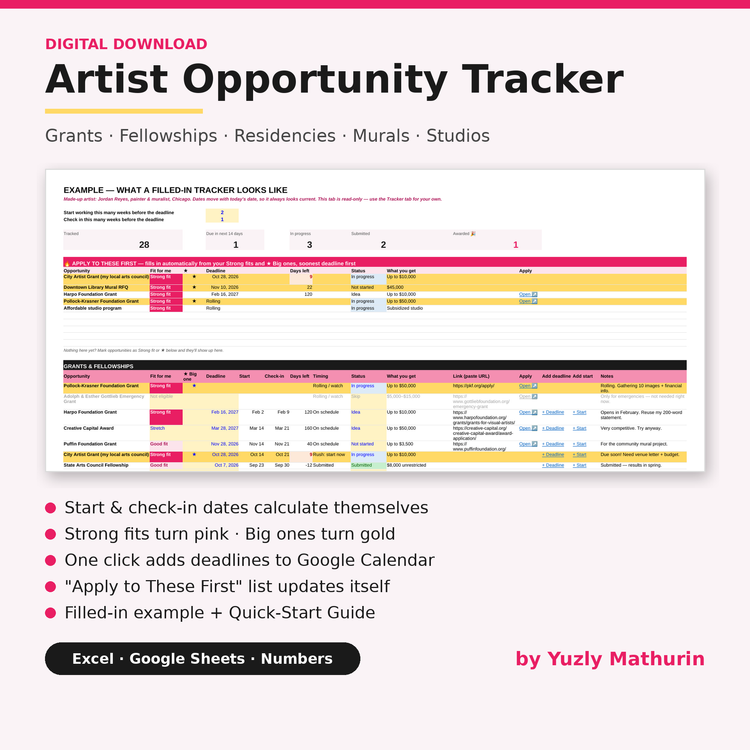
Digital download · $15
Artist Opportunity Tracker
This is the same tracker I use to apply to museum fellowships, residencies and paid mural calls. Add a deadline and it works out when to start and when to check in. Strong fits turn pink, your big ones turn gold, and one click adds each date to Google Calendar.
It includes a filled-in example, a self-updating "Apply to These First" list, an Application Kit checklist, a list of where to find new calls, and a Quick-Start Guide. Works in Excel, Google Sheets and Numbers.
Get the trackerKnow an opportunity I should add? Message me on Instagram. Join my mailing list to get the next list first.